Subterranean termite barrier defense deploys a contiguous zone of treated soil along the structural foundation perimeter to intercept native subterranean termites ( USDA ARS taxonomy classification Reticulitermes ). In…
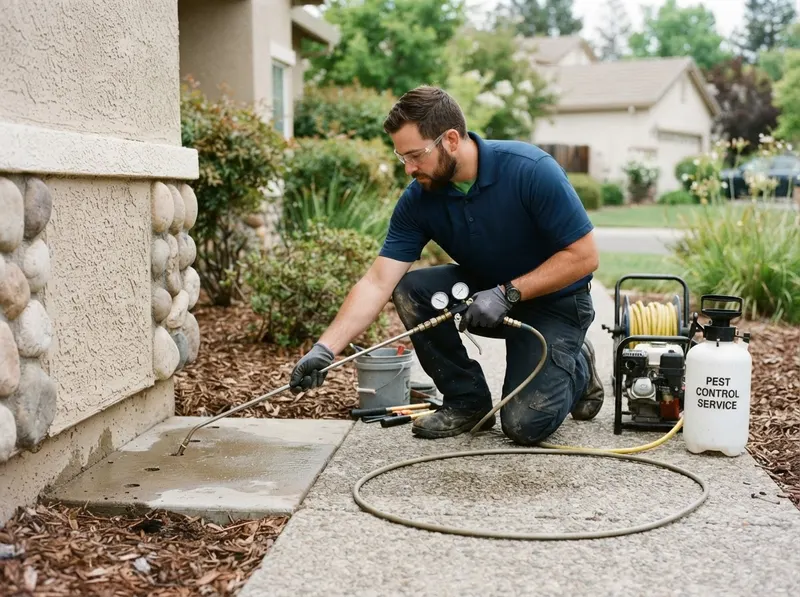
Subterranean termite barrier defense deploys a contiguous zone of treated soil along the structural foundation perimeter to intercept native subterranean termites (USDA ARS taxonomy classification Reticulitermes). In Placer County, native colonies nest deep underground to survive regional summer temperatures exceeding 100 degrees Fahrenheit, ascending via exploratory shelter tubes through foundation shrinkage cracks, cold joints, and plumbing conduits. Properties in Westpark, Fiddyment Farm, and Sierra Vista built over disturbed clay hardpan frequently exhibit settlement hairline fissures as narrow as 1/32 of an inch, providing adequate ingress for subterranean foragers. Rather than using surface repellents that pests simply detour around, barrier defense uses non-detectable liquid termiticides complying with EPA guidelines. Termites tunnel through the treated threshold without detection, transferring the active ingredient back to the central subterranean brood chamber to achieve complete colony neutralization.
Execution requires precise mechanical access along the exterior stem wall and slab-on-grade perimeters. Soil is excavated into a continuous 6-inch-wide by 6-inch-deep trench immediately adjacent to the foundation footings, calibrated at an application volume of 4 gallons per 10 linear feet per foot of depth according to California Department of Pesticide Regulation specifications. Where exterior flatwork, such as driveways, poured patios, and entry courtyards in Highland Reserve and Blue Oaks, abuts the structural foundation, concrete is systematically core-drilled at 12-inch intervals using a 1/2-inch carbide masonry bit. High-pressure sub-slab injectors introduce the barrier beneath the concrete substrate before each hole is sealed with non-shrink hydraulic concrete plugs. For older crawlspace foundations common in Cirby Ranch and Crestmont, perimeter footings receive double-sided trenching alongside interior pier block saturations to secure vulnerable timber subflooring.
Establishing an continuous chemical envelope requires distinct technical deployment compared to surface broadcast spraying or localized baiting. Surface perimeter sprays fail entirely against subterranean species because workers navigate subterranean strata up to 18 inches below the turf grade. While exterior monitoring systems documented through the National Pest Management Association offer auxiliary detection, active structural infestations demand an immediate, uninterrupted liquid exclusion zone to prevent severe structural load failure. In properties bordering riparian corridors like the Miner's Ravine Trail or agricultural easements in Sun City Roseville, moisture gradients accelerate foraging activity, requiring rigorous evaluation of grade levels, irrigation zones, and perimeter weep screeds according to standard building metrics verified by the International Code Council. Clear grade clearance must be maintained between exterior mulch beds and foundation framing to prevent bridging across the finished barrier.
Every job gets a firm, written price after a free on-site visit.
For standards, safe disposal, and service guidance on pest control services in Roseville, CA, useful references include U.S. EPA, ENERGY STAR, U.S. Dept. of Energy, Consumer.gov, U.S. Census Bureau, and Google Maps. General consumer and small-business resources are available from USA.gov, Better Business Bureau, FTC Consumer Advice, U.S. Small Business Administration, and Ready.gov.
Tell us about your subterranean termite barrier defense job in Roseville and we'll send a clear, written quote, usually the same day.
 Precision Pest Care